




 A core leadership challenge has emerged across multiple clients this year: how to move leaders from optimizing for their own team or function to owning outcomes for the whole enterprise.
When tailoring or developing new business simulations, we talk to many leaders across our client organizations. More often, we hear things like this:
-
“How do we make sure that we're not just thinking about our business but always keeping the customer at the center?”
-
"What would really help is if this group internalizes the value that cross-enterprise partnership brings, like breaking silos and working across teams.”
-
"They need to learn broadly about our enterprise so that they can not only impact their function but also impact the business as a whole.”
No one argues against the principle of enterprise-wide thinking. Like so many vital leadership principles, it is simple to understand in theory and challenging to implement under the pressure of day-to-day operations and demanding functional or business unit goals.
Our Enterprise Mindset model™ identifies five actionable behaviors that build the awareness and habit of considering the entire enterprise.
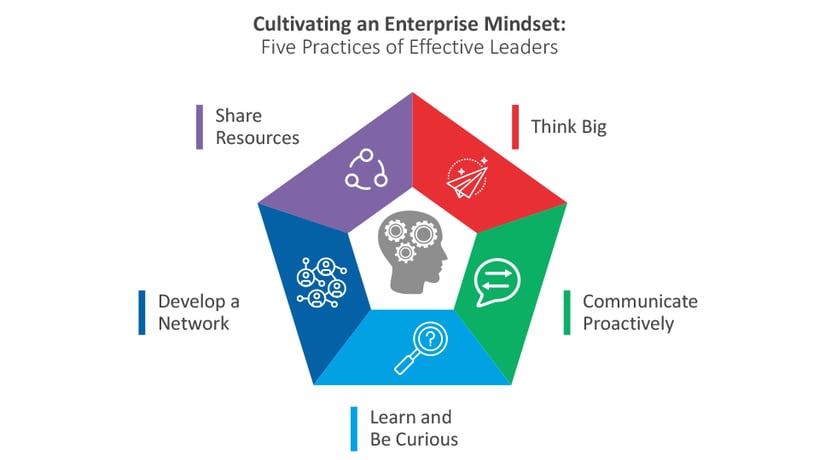
Again, these are easy to support and hard to do. That’s because the daily demands of your job—competing deadlines, your own team’s goals, the pull to focus on what’s immediately in front of you—leave little room to practice a wider, enterprise-level view.
To help move out of the theoretical and into the practical, here are suggestions you can implement now for each of the five areas of our Enterprise Mindset model.
Share Resources
-
Pay attention to your default response to a request for resources. Do you quickly say no to protect your team and your goals? Do you push yourself to say yes in a people-pleasing way? Do you freeze in indecision, torn between protecting your team and doing what ‘s best for the enterprise?
-
When you know your default, push yourself to consider other responses. What would the opposite answer mean? What benefits would flow and what are the drawbacks you would need to manage? What other solutions are possible that meet as many needs as possible?
-
Remember the adage that doing what’s right for the business is rarely a bad idea. Take the long view, honestly and objectively assess the situation, and make the choice that benefits the entire enterprise.
-
Try on the attitude “we can afford to be generous” and see how it feels. Explore what it would take to be generous before giving a quick no to requests.
-
Share what you need and ask for what would help your organization say yes. Resources aren’t just headcount and budget. Another team might have information, best practices, or SOPs you need, and you might have expertise or process knowledge that helps them grow too. When you share, you refine your understanding. When you receive, you expand your knowledge.
Think Big
-
Stop when you say, “my team.” Is it your team? Or is it really your organization’s team, one you lead on behalf of the organization’s vision and mission?
-
Consider the broader organization and the distinct purpose each department serves within the bigger whole. For example, one product line might be highly profitable, another barely profitable but an easy entry point for new customers, and another complex and expensive to maintain but with high loyalty and a source of steady income even in downturns, showing how each contributes differently to the enterprise’s overall health.
-
Expand your time horizon when making decisions. Play out different options further into the future and see what clarity arrives.
-
Look around corners. What might your enterprise’s offerings need to look like in five or 10 years to keep serving customers well? Think big about where the business is headed.
-
Consider the larger culture and context. What’s happening in politics, economics, social trends, and generational shifts? How do these matter to the decisions you’re making now?
Communicate Proactively
-
Open meetings by connecting the topic to the relevant strategy before diving into details.
-
Ask questions about how decisions will affect other parts of the business or other customers.
-
Remind people about what is happening in other parts of the organization that relates to the topic at hand.
-
Send a quick message to a colleague in another area or someone on your team rather than waiting to perfect a communication. Get the conversation started.
-
When starting or finalizing a decision ask:
-
Who needs to know about this?
-
Who will be affected by it?
-
Who could contribute to this?
-
Who may also be doing something similar to this?
-
Learn and Be Curious
Curiosity is a habit you can build anywhere, not just at work. The more natural it becomes in daily life, the more automatically it shows up in the business decisions that matter.
-
Carry a question that interests you as a conversation starter across situations (with friends, airplane seatmates, colleagues, or neighbors). Make it something you genuinely want to learn about across contexts. Possibilities:
-
How do you handle all the uncertainty and upheaval we face these days?
-
What is your guiding light when things get tough?
-
What are you excited to learn more about?
-
What is something you’re proud of achieving? How did you do it?
-
-
Read articles or listen to podcasts about content you don’t typically consume or reach out directly to a leader in another business unit to learn what they do. Get ideas from a different function’s perspective, another industry, or a faraway geography and push yourself to apply what you learn to your challenges.
-
Pay attention to whatever catches your attention because it doesn’t make sense, seems out of place, or even makes you uncomfortable. Get more information and see where the path leads—likely to a new insight, an important use case, or maybe even a mistake you can prevent.
-
Ask follow-up questions to get at underlying thinking: What made you do that? Why was that important? What else did you consider?
-
Use travel or commute time to let your mind wander and connect ideas you already have, instead of adding new knowledge or achieving one more task.
Develop a Network
-
Sign up and attend learning events. Sit with people you don’t know and then introduce your friends to them.
-
Go to trainings and events offered by other functions or divisions in the company.
-
Set out to meet people in person who you only know from virtual meetings.
-
Give yourself a target number of people to meet in different functions.
-
Engage different business partners in conversations about the entire organization’s vision and strategy and how it affects them. Listen for overlaps and differences with your strategic priorities.

Part of what I love about our leadership simulation programs is that they counter these typical pressures. As a participant, here’s what that looks like:
-
You’re out of the office and connect with colleagues you don’t know from across your organization.
-
The simulation compresses time, so you see business results based on decisions you make within hours or days, not months or years.
-
You’re placed in a role more senior than your current role, where you are responsible for seeing a bigger picture.
-
You work with a team of peers who have different experience and expertise. You work together to make key business decisions. You debate and share stories. You learn about their line of work.
-
You set strategy and then implement it, assessing what your organization, the market, and potential customers need.
Ready to accelerate the work? A simulation-based leadership program condenses these five behaviors into a single, immersive experience. Reach out to see how a program like ours can jumpstart your team’s enterprise mindset.