Business acumen is the understanding of what drives a business’s performance. It combines knowledge of how a business makes money; how different parts of an organization work together to drive performance; and awareness of its markets, competitors, and customers. Business acumen enables people to make well-informed decisions that contribute to a company’s success. It matters to all people in all roles and levels, not just those with profit and loss responsibility.
Let’s consider how an event we all know well, a flight delay, can reflect deep business acumen.
Key takeaways:
-
An idea can look different when you consider it from the multiple lenses of business acumen.
-
Business acumen combines three lenses: Market Perspective, Financial Acumen, and Business Systems Thinking.
-
People in every role, from maintenance planners to marketers, make decisions that affect results, so everyone benefits from business acumen.
A Delayed Flight and a Great Question
I was catching up with a group of friends recently when one of them shared the story of a frustrating travel day. Their flight out of Boston was delayed for hours. A critical communications part on the plane had broken, and the airline had only two of those parts available on the entire East Coast. One had to be flown up from Atlanta before the plane could leave the gate.
We all groaned in sympathy. Then someone at the table said what everyone was thinking: "Why don't airlines just keep a backup of every part at every airport?"
It's a great question. Doing so would be practical and customer focused. It would have gotten my friend home earlier. And as soon as I heard it, a second thought popped into my head: Holy smokes, keeping the spare part at all airports would cost a lot of money.

Great Idea. Now Let's Do the Math.
The idea is a good one from the customer's seat. Look at it from the business' seat and it gets complicated—and expensive—fast.
Let's run some simple numbers. Say that part costs $50,000, and the airline flies into 150 airports. (I'm making up the part price and the airport count to keep the math easy.) Stocking one spare everywhere puts $7.5 million on shelves for a single part. Carrying costs, which cover storage, insurance, shrinkage, obsolescence, and the cost of the cash itself, often run 15 to 30% of inventory value each year. That's roughly $1.1 to $2.25 million a year to hold a single part at 150 airports, most of which will rarely, if ever, use it.
Now multiply that by the thousands of parts that keep a fleet flying.
This is where inventory turns come in. Inventory turns measure how often a business uses up and replaces its stock. A spare sitting in a small regional airport for years barely turns at all. It's cash frozen on a shelf, cash that can't go toward new aircraft, better service, or the bottom line.
So the airline makes a trade-off. It keeps critical parts at key hubs and accepts that, now and then, it might need to fly a part from Atlanta to Boston or another location. My friend's delay wasn't a failure of common sense. It was a business decision that required managing trade-offs about costs, risk, and customer experience.
Three Lenses on One Broken Part
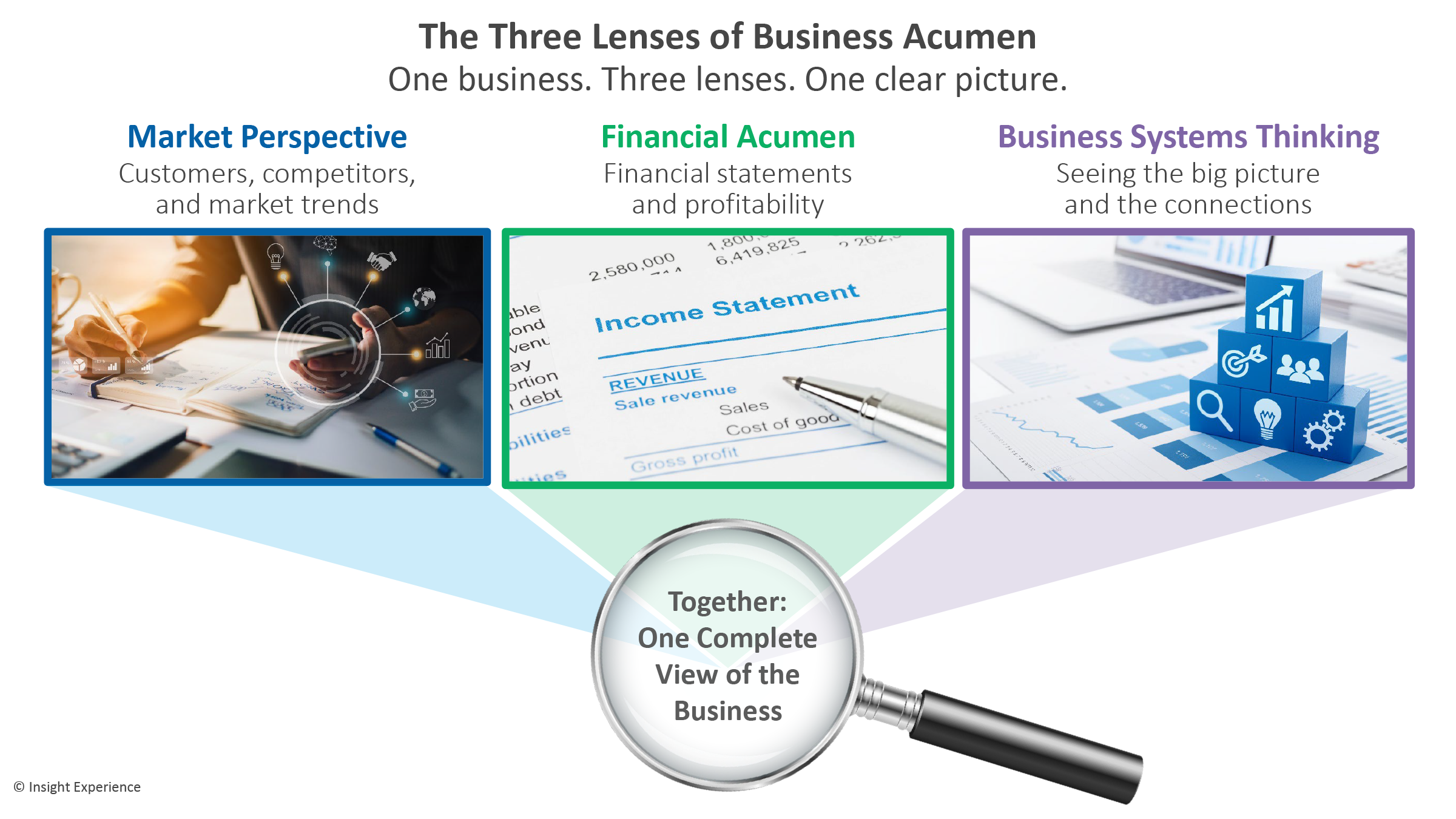
At Insight Experience, we look at business acumen through the Lenses of Business Acumen™, three connected perspectives: Market Perspective, Financial Acumen, and Business Systems Thinking. That question shows why you need all three.
-
Market Perspective. Airlines compete in a crowded, price-sensitive market where customers often shop on fare first. Carriers can't simply raise prices to cover the cost of a spare part in every city. Knowing how your market works—and what customers will and won't pay for—shapes the investments and priorities that a business can afford.
-
Financial Acumen. Inventory isn't free just because it's sitting still. Idle inventory ties up cash, carries ongoing costs, and drags on financial returns when it isn’t put to use. Seeing how a decision flows through to the income statement, the balance sheet, and cash flow is what turns a reasonable idea into a sound decision.
-
Business Systems Thinking. Every choice ripples. Hold fewer spare parts and you save cash, but you risk delays that affect on-time performance, crew schedules, passenger connections, and customer loyalty. Hold more and you may ensure on-time performance and protect customer loyalty, but doing so is expensive. Neither choice is perfect. Good decisions come from seeing how the pieces connect and understanding their trade-offs.
Looking through one lens gives you a partial picture. The person at the table saw the customer side clearly. The airline has to see all three at once.

Why Do Employees Without P&L Responsibility Need Business Acumen?
Here's what struck me most. The person who asked the question wasn't wrong. But they were missing context. And that same gap exists inside almost every organization.
We tend to think of business acumen as a skill for executives and people with formal P&L responsibility. But the decisions that shape results happen every day, all across the business, and by all employees. Think about who touches that one broken part:
-
The maintenance planner deciding which parts to stock and where to place them
-
The procurement specialist responsible for negotiating prices and delivery terms
-
The operations team choosing whether to delay the flight, cancel the flight, or find another aircraft
-
The gate agent explaining the delay to a frustrated customer
-
The customer service rep deciding what compensation to offer to displaced travelers
None of them owns the P&L. Every one of them affects it.
The same is true in your organization. An engineer developing a new feature, a marketer planning a promotion, a sales rep offering a discount, an HR leader designing a benefit: Each one is spending, saving, or generating value. When people understand how their work impacts financial performance and other parts of the business, they make better trade-offs and decisions on their own. They ask sharper questions. They bring ideas that are both practical and affordable.
When they don't, you get well-meaning ideas that would quietly erode the business. And you get frustration when leaders say no without anyone understanding why.
Building Business Acumen at Every Level
The good news is that business acumen can be learned, and it doesn't require turning everyone into an accountant or finance professional. The goal is fluency: knowing how the business makes money, what drives cost and cash, and how your decisions connect to bottom-line results.
That fluency builds best through experience. In an Insight Experience business simulation, participants step into the role of running a business. They make the same kinds of trade-offs the airline faces: how much inventory to hold, what investments to make, how to respond when the market shifts. Then they see the results show up in the financials. They learn by doing, reflect on what happened in a structured debrief, learn from their peers, and connect it all back on the job.
That's when the "aha" moments happen. Someone realizes that a discount that won the deal also squeezed profit margins. Or that holding extra inventory felt like the right thing to do for customers, but it ended up tying up scarce resources the business needed for other purposes.
The next time someone in your organization asks, "Why don't we just…?", you want them to be able to answer their own question, and maybe find a better idea in the process. That's the power of business acumen in every role.
*******
Frequently Asked Questions
-
What is business acumen? Business acumen is the understanding of what drives a business’s performance. It combines knowledge of how a business makes money; how different parts of an organization work together to drive performance; and awareness of its markets, competitors, and customers. At Insight Experience, we break it into three lenses: Market Perspective, Financial Acumen, and Business Systems Thinking.
-
Who needs business acumen? Anyone whose decisions affect cost, customers, or cash, which is nearly every role. Maintenance planners, procurement specialists, engineers, marketers, and HR leaders all make trade-offs and decisions that shape results, even without formal P&L responsibility.
-
How do you build business acumen? The goal is fluency: knowing how the business makes money, what drives cost and cash, and how your decisions connect to results. That fluency builds best through experience. In a business simulation, participants make trade-offs, see the results in the financials, reflect in a structured debrief, and connect it back on the job.
Want to see how this works in practice? Join Ned Wasniewski on Tuesday, Nov. 10, at 12 p.m. ET (9 a.m. PT) for How Simulations Develop Business Acumen in Leaders. Register here.
Ready to build business acumen across your organization? Explore our Business Acumen programs or reach out at info@insight-experience.com to start the conversation.
References:
International Air Transport Association. (2026a, June 7). Middle East disruptions and high fuel prices halve airline industry profitability (Press Release No. 26). https://www.iata.org/en/pressroom/2026-releases/06-07-middle-east-disruptions-high-fuel-prices-halve-airline-industry-profitability/
International Air Transport Association. (2026b, June 19). Profits and margins to shrink in 2026 - but remain positive [Chart of the week]. https://www.iata.org/en/iata-repository/publications/economic-reports/profits-and-margins-to-shrink-in-2026-but-remain-positive/