




Editor's Note: This post draws from our recent live event on this topic. Watch the full recording or read our introduction to leadership simulations.
Most leaders develop their capability while doing the job itself. Every decision, conversation, and trade-off shapes how they lead.
A leadership simulation creates a practice field for your leadership.
It is an immersive environment where leaders step into realistic situations, make decisions, and experience the consequences of those decisions in real time. The experience is designed to reflect the complexity of leadership, requiring participants to think, act, and respond as they would in their roles.
The result is a focused space to actively practice leadership, build judgment, and strengthen capability through experience.
How Do You Define a Leadership Simulation?
A leadership simulation is an immersive, experiential learning environment where leaders make real decisions with real consequences in a safe, risk-free context. Leadership simulations balance analytical decisions (executing projects, managing resources, reading financials) with interpersonal ones (coaching direct reports, navigating conflict, influencing stakeholders across the organization).
Most leaders have encountered business simulations that focus on financial mechanics: managing inventory, optimizing margins, or allocating capital. Those are valuable, but they often miss half of the equation.
That balance matters because the human skills — presence, judgment, and the ability to develop someone else's capability — are precisely what AI cannot replicate. And they're exactly what separates good managers from great leaders.
How Does a Leadership Simulation Work?
Consider a scenario: Kelly, a recently promoted senior analyst, comes to her manager with a problem. She's leading a high-visibility deliverable, but two senior stakeholders are pushing in opposite directions: One wants speed, and the other wants ambition. She can't recommend both.
What does her manager do?
-
Take over and make the call?
-
Work alongside her?
-
Coach her to navigate the stakeholders herself?
In a leadership simulation, every choice has a measured outcome. Taking over gets the deliverable done fastest, but Kelly's motivation drops significantly. She'd been building relationships and wrestling with a real problem; removing it sent a perhaps unintended message that she was not equipped to solve the problem herself. Coaching her takes longer in the short term, but her skills improve across motivation, people capabilities, and business acumen. And the next time something like this comes up, it takes half as long.
This is the Business Cycle of Leadership™ in action: how leaders show up (how they communicate, allocate time, develop their people) directly shapes the quality of work their teams can deliver, which ultimately drives business results.
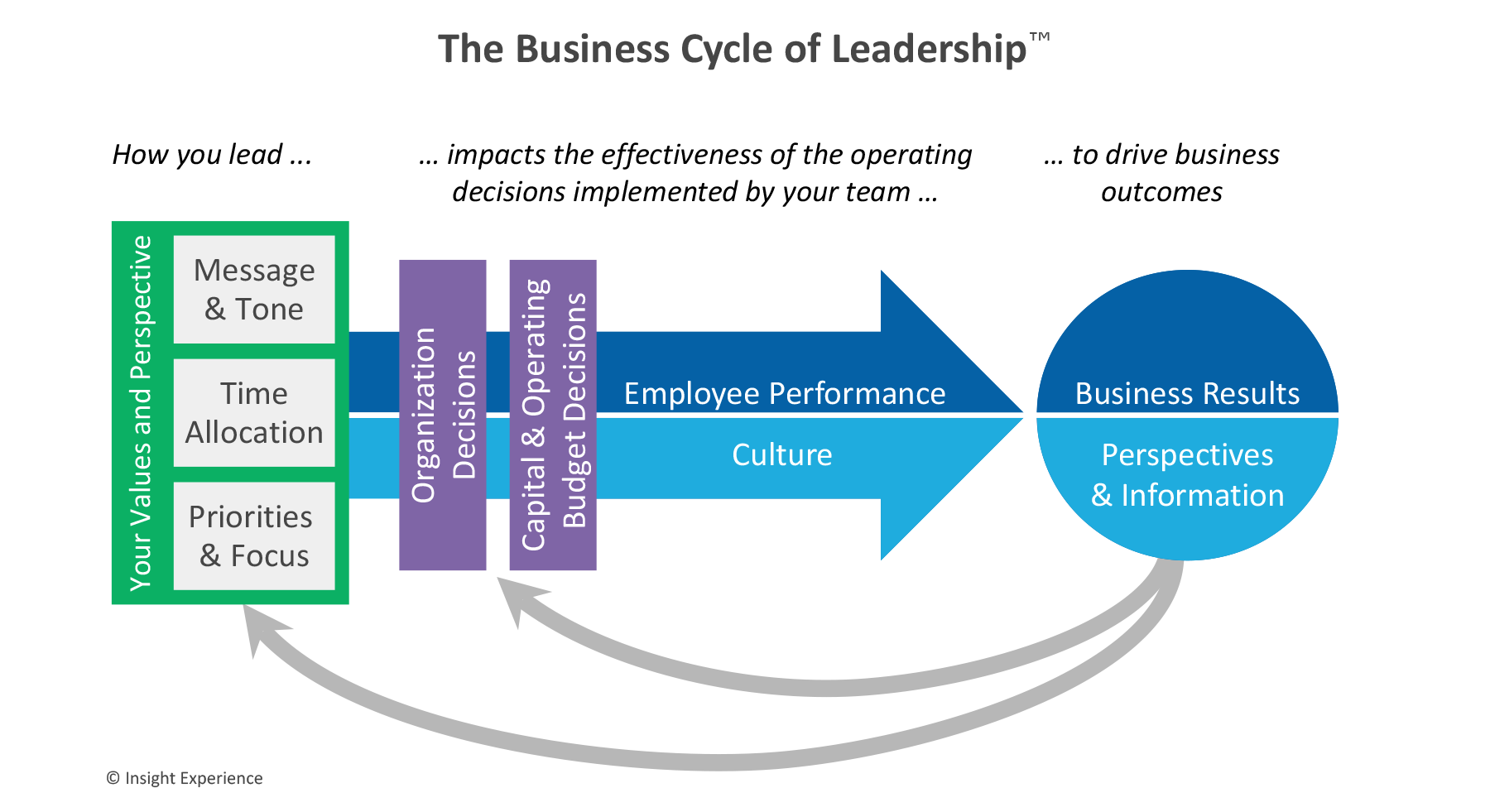
Over the course of a leadership simulation, leaders work through multiple rounds of decisions, representing months or quarters in the business; see the downstream impact of their choices; and reflect on what those patterns reveal about how they lead. That accelerated feedback loop isn't possible in real life.
What does a Leadership Simulation Look Like from the Participant Perspective?
Leadership simulations begin with a case study that introduces the business context leaders are stepping into. This backdrop provides the key dynamics, challenges, and stakeholders that will shape their decisions.
Very quickly, participants move into decision-making. Working in teams, they navigate a series of scenarios that require them to align on priorities, make trade-offs, and take action. The team-based structure is intentional. It creates space for leaders to share perspectives, challenge assumptions, and learn from peers with different backgrounds and experiences.
As the simulation progresses, teams see the outcomes of their decisions. This sets up one of the most valuable moments in the experience: the debrief. Participants come together to compare how different strategies led to different business results, making it easier to see the impact of their choices.
This entire process enables reflection and application. Leaders step back to consolidate what they learned, identify patterns in their own leadership, and define what it means for their role. The focus shifts to “so what” and how they will apply these insights back on the job.
What Skills Does a Leadership Simulation Develop?
The range is broad, and the best leadership simulations are tailored to what a specific organization aims to build. Common focus areas include:
-
Developing others. How many of a leader's decisions are designed to grow their people versus decisions that create dependency? Simulation data can surface exactly how often leaders are choosing to teach versus tell and what that pattern costs over time.
-
Time allocation. Leadership simulations can model a real-world dynamic: Teams that invest in coaching and alignment reclaim hours previously lost to crises and firefighting. By building their leadership bench, those urgent issues never reach their desks in the first place.
-
Strategic thinking. How effectively do leaders scan their environment and pay attention to trends affecting their business and their customers? In a recent program with 25 teams, most leaders focused internally and missed the broader landscape entirely. Seeing that data sparked one of the most important talent conversations the client had all year.
-
Framework reinforcement. Every decision can be mapped to the specific leadership behaviors an organization wants to build. This gives participants a feedback loop each round showing how their choices measured up.
How Do You Measure the ROI of a Leadership Simulation?
Leadership simulations can have real impact on the business. Some of our clients have seen:
-
A 47% improvement in strategic communication skills across simulation rounds during a program (medical devices company).
-
The rise of retention rates to 93% against an 87% industry average (healthcare client).
-
Recent NPS scores of 95 (manufacturing), 93 (global retail), and 82 (digital media).
Beyond pre/post assessments, Insight Experience's Insights & Analytics capability allows program sponsors to analyze trends in decisions to inform organizational insights or additional training requirements.
Is a Leadership Simulation Worth It?
Every leadership decision has a downstream cost or benefit that can feel nearly impossible to see in real life. When you take over instead of coaching, you don't get an alert that Kelly's motivation just dropped. When you invest in developing your people, there's no dashboard showing you the fires that never reached your desk.
That's the real argument for leadership simulations. They give leaders the one thing real life can't: a practice field for their leadership. When leaders have the chance to practice and see the impact of their decisions, they lead with greater clarity, confidence, and intention.
Ready to give your leaders that practice field? Let's talk.