




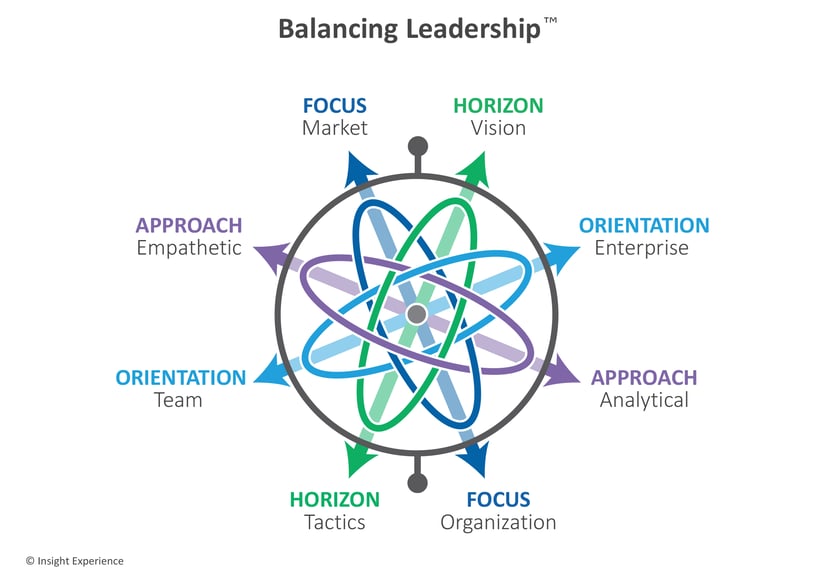
Ed. Note: This post, originally published in 2014, was updated in 2025 to reflect the addition of a fourth dimension to our Balancing Leadership™ model.
Leadership is a great balancing act. It involves balancing the outside world and the inside organization; the team and the enterprise; the head and the heart; and the short term and the long term. Leaders relentlessly live F. Scott Fitzgerald’s famous quote: "The test of a first-rate intelligence is the ability to hold two opposed ideas in mind at the same time, and still retain the ability to function."
Great leaders are not one-dimensional.
Whether in politics, business, society, athletics, or any other field of endeavor, great leaders succeed by balancing multiple dimensions of both perspective and skill.
Four dimensions are particularly important.
Focus
Do you orient your thinking outside-in or inside-out?
An outside-in perspective, grounded in the market and customer view, ensures that you and your organization stay focused on meeting real needs, delivering value, and understanding the jobs your products and services are hired to do. Without this external lens, organizations risk irrelevance, becoming obsolete before they even realize it.
But effective leaders also embrace the inside-out perspective:
-
What are we great at?
-
Where do we struggle?
-
Are our culture and values helping us move forward or holding us back?
Without this organizational self-awareness, even the best strategic plans wither, unexecuted.
Orientation
Do you lead as the head of your team, or as the leader of the enterprise?
A team mindset keeps you focused on the results directly within your control: the people, priorities, and performance of your own unit. But an enterprise mindset pushes you to think beyond your function: to weigh trade-offs and make decisions on behalf of the whole organization, not just your piece of it.
Without that shift, leaders risk optimizing their own area at the expense of the broader business.
Approach
Do you leverage your leadership on your cognitive analytical capabilities or on your interpersonal and empathetic ability to engage others?
Effective leaders must synthesize today’s overwhelming flood of information, distilling what matters most to set direction and evaluate performance. But they must also engage, motivate, and build emotional connections with employees, customers, and partners.
Relying on one without the other falls flat.
Horizon
What is your field of vision?
Like the headlights on a car, great leaders must shift between high beams, which show the long-term horizon, the vision, and the potential for success, and low beams, the tactical day-to-day actions that move the organization forward.
Rosabeth Moss Kanter wrote in an article at Harvard Business Review about the importance of leaders zooming in and zooming out. Her view is that these perspectives need to be “vantage points, not fixed positions.”
We see this dynamic play out in our business simulations. Even in microcosm, leaders often struggle to balance these four dimensions: outside-in vs. inside-out, team vs. enterprise, analytical vs. empathetic, and strategic vs. tactical. In high-pressure situations with tight deadlines or rising conflict, it’s easy to get pulled toward the immediate, the tactical, the internal, and the team-focused. Ironically, it’s in those very moments, when the stakes are highest, that leaders most need to stay balanced.
Are you a balanced leader? Our Enterprise Leadership programs help leaders build the range to move fluidly across all four dimensions, especially the enterprise mindset critical to leading at scale.
References
Kanter, R. M. (2011, March). Managing yourself: Zoom in, zoom out. Harvard Business Review. https://hbr.org/2011/03/managing-yourself-zoom-in-zoom-out